 Duluth Water Leak Detection Pros
How Do Duluth Weather and Soil Affect Hidden Leaks?
Duluth weather and soil, in ZIP codes 30096 and 30097, affect hidden leaks in general ways: rain separates roof leaks from plumbing leaks, humidity feeds condensation, and ground movement stresses underground lines. No specific figures are claimed here. The patterns, not the numbers, help you read a leak.

Weather and soil are often blamed for leaks, and sometimes fairly — but usually in general terms, not in the precise figures that some guides invent. A guide that quotes a rainfall total or a soil expansion percentage for Duluth without a source is guessing, and guessing does not help a homeowner. What does help is understanding the patterns: how rain, humidity, and ground movement each change what a leak looks like, and what each pattern points to.
Rain: the separator
Rain is the most useful weather pattern for reading a leak, because it separates causes. A stain that grows only after rain, with a meter that does not move, points to a roof or exterior entry point, not to a supply pipe. A stain that grows regardless of weather, with a meter that moves, points to supply. A stain that grows after rain and also after upstairs use may be two issues, or one issue misread — and the inspection separates them rather than forcing a single answer. That is why noting when a stain grows, dated, is worth more than any weather statistic.
Heavy rain can also reveal a leak that was already there. Ground saturation can make an underground leak show as a soggy patch, and a roof leak that was slow can become visible in a storm. Rain does not usually create a supply leak, but it can make one visible — which is why a leak that “appears” in a storm still deserves a meter test before it is assumed to be rain-related.
Humidity and condensation
Humidity feeds condensation, and condensation feeds ceiling and wall dampness that looks like a leak. A damp patch that appears in humid conditions, in a bathroom or a poorly ventilated room, with a still meter and no upstairs source, points toward condensation or ventilation rather than a pipe. The fix in that case is ventilation, not plumbing, and a plumber cannot fix it. The inspection's job is to rule out plumbing first, so the right trade is called — and the meter test is the check that does that ruling out.
Soil and ground movement
Soil moves, in general terms, with moisture: it swells when wet and shrinks when dry, and that movement stresses underground lines and joints. A line that was sound can develop a joint failure after repeated swelling and shrinking, and a line that already had a weak joint can fail sooner. That is a pattern, not a prediction for any one property — soil type, line depth, and line material all change the picture, and no guide should claim a specific movement figure for Duluth without a source.
Ground movement also explains why an underground leak can be intermittent. A joint that leaks when the ground is saturated and seals when it dries, or vice versa, will show a meter pattern that changes with weather. That is worth noting on the call: a meter result that varies with conditions is itself useful information, and it can change which checks are used.
What to note, season by season
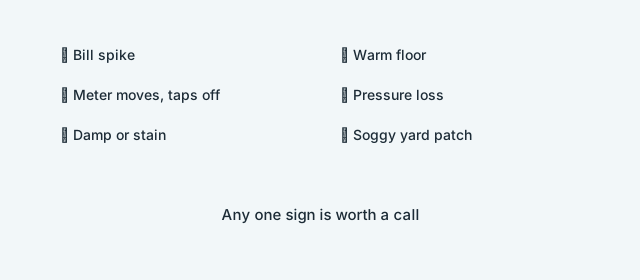
Seasonal notes are more useful than seasonal statistics. In wet periods, note whether stains grow after rain or regardless of it. In humid periods, note whether dampness appears in bathrooms and unventilated rooms with a still meter. In dry periods, note whether a yard patch stays soggy when everything else dries — a soggy patch in dry weather points to a line leak, not to rain. Those three notes, dated, are the seasonal record an inspection can actually use.
Weather, soil, and hidden leaks in Duluth, GA
For a Duluth home, the practical takeaway is to read patterns, not numbers. Rain separates roof from plumbing. Humidity separates condensation from plumbing. Ground movement explains why an underground leak can come and go. And the meter test separates supply from everything else, in any season. That is the whole weather and soil guide, honestly stated: patterns you can observe, checks you can do, and no figures invented to fill the gaps. The service pages that cover the locations are underground and ceiling leak detection.
Reading your own property's pattern
The most useful weather record for a leak is not a climate table — it is your own property's pattern, kept in a simple diary. Four columns are enough: date, what you saw (stain, damp, soggy patch, bill spike), what the weather was doing (rain, humid, dry), and what the meter did. Two or three months of those notes, even sparse ones, are worth more than any general weather guide, because they show how your property behaves, not how properties in general behave.
That diary also helps the inspection in a concrete way. A meter result that varies with weather, a stain that grows only after rain, a yard patch that stays soggy in dry weather — each of those patterns points the inspection toward a different cause, and each one saves narrowing time. An inspection that starts with a diary starts further along than one that starts with a vague memory of “it has been damp for a while.” If you are reading this guide because you already have a sign, start the diary now, even before you call: the first entry is the day you noticed it, and every entry after that makes the next step clearer.
One more practical note: photograph the diary entries alongside the signs themselves. A photo of a stain with a date, a photo of a meter reading with a date, and a photo of a yard patch with a date, kept together, are the record that any later discussion — with a plumber, with an insurer, with a buyer — will rely on. Dates turn observations into evidence, and evidence is what turns a pattern into a decision.
When weather makes a leak harder to find
Weather can make a leak harder to find, not just easier to notice. Heavy rain saturates the ground, which can mask an underground leak's soggy patch — everything is soggy, so nothing stands out. High humidity raises background moisture readings everywhere, which can mask a localised damp patch in a wall or ceiling. And dry weather can make a slow leak look like it has stopped, when it has only slowed with reduced usage or changed ground conditions. Each of those effects is a reason to repeat checks in different conditions, rather than trusting a single visit in a single weather window.
If an inspection is inconclusive, weather is a legitimate part of the explanation — and the next step should be named, not left vague. A re-check after rain, a re-check in dry conditions, or a meter test over a longer wait can each resolve a weather-masked result, and the report should say which one is needed and why. An inconclusive result with a named next check is useful; an inconclusive result with no next step is just an open question, and it should not be presented as anything else.
Common questions
Does rain cause plumbing leaks?
Rain does not usually create a supply leak, but it can make one visible — ground saturation can reveal an underground leak as a soggy patch, and a storm can make a slow roof leak obvious. A leak that appears in a storm still deserves a meter test before it is assumed to be rain-related, because supply and roof leaks can coincide.
Can humidity alone cause a ceiling stain?
Yes. Condensation forms where warm, humid air meets a cold ceiling surface, and over time it can stain ceiling materials. It does not move the meter, it does not follow rain, and it is usually linked to ventilation rather than to a pipe. A ventilation check is the next step once plumbing is ruled out.
Does soil movement really break pipes?
In general terms, yes: soil swells when wet and shrinks when dry, and that movement stresses underground lines and joints. A line with a weak joint can fail sooner under repeated movement. That is a pattern, not a prediction for any one property — soil type, line depth, and material all change the picture.
Why does my yard leak come and go?
An underground joint can leak when the ground is saturated and seal when it dries, or vice versa, so the meter pattern can change with weather. Note when the leak appears and what the weather was doing — a meter result that varies with conditions is itself useful information for the inspection.
Should I wait for dry weather before calling?
No. A leak that is visible in wet weather is still a leak, and waiting lets it spread. Call with the pattern noted — when it grows, what the meter did, and what the weather was doing — and let the inspection read the pattern rather than waiting for a cleaner one.