 Duluth Water Leak Detection Pros
Does Homeowners Insurance Cover Leak Detection in Georgia?
Homeowners insurance in Georgia usually treats leak detection, water damage, and access to the leak as three different costs, and coverage differs for each. This guide explains the distinction, what documentation helps, and what to ask your carrier before work starts.
“Is this covered?” is one of the first questions after a leak is found, and it is also one of the hardest to answer without the policy in hand. The reason is not that insurers are evasive — it is that a leak creates three separate costs, and a policy can cover one, two, or none of them. Understanding the three-way split before you call your carrier is the difference between a useful conversation and a frustrating one.
One caution first: this guide is general information about how leak-related costs are usually treated, based on the way competitor guides and insurer explanations describe them. It is not insurance advice, it does not interpret your policy, and it does not promise coverage. Policies vary, endorsements change the answer, and the only authority on your claim is your carrier and your policy wording.
Detection, damage, and access are three different costs
| Cost | What it is | Usually treated as |
|---|---|---|
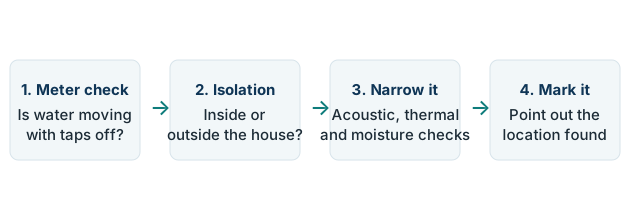
| Detection | Finding and marking the leak (meter, isolation, acoustic, thermal, moisture checks) | Often treated as part of the repair investigation, not as damage itself |
| Damage | Water damage to walls, ceilings, floors, and contents | The cost most often covered, when the cause is a covered peril |
| Access | Opening a wall or ceiling to reach the leak, and restoring it afterwards | Sometimes covered, sometimes limited, depending on the policy |
The split matters because a claim can succeed on damage while detection or access is limited, or vice versa. A homeowner who assumes “the leak is covered” and then finds detection is treated separately can be surprised by a bill that is technically correct under the policy. Asking your carrier to address all three costs separately, before work starts, avoids that surprise.
Sudden vs gradual: the distinction that decides most claims
The distinction most guides return to is sudden versus gradual. A sudden, accidental leak — a pipe that bursts, a joint that fails without warning — is usually treated as a covered peril, and the resulting damage is usually covered. A gradual leak — a slow seep that has been staining a ceiling for months, or a leak that was known about and left — is usually treated as maintenance, and the damage is usually not covered. The line between the two is not always sharp, and it is often where claims are decided.
That is why documentation matters more than argument. Dated photos of when the stain first appeared, the meter result, the detection report with its ruled-out list, and any record of when the problem was first noticed all help show whether a leak was sudden or gradual. A stain that was painted over and left for a year tells a different story from a stain that was photographed, reported, and inspected promptly — and the difference can be the claim.
What documentation helps a claim
- Dated photos. The stain, the water, and the meter reading, taken before anything is painted or opened.
- Detection report. What was ruled out as well as what was found: meter result, upstairs checks, method results, and the marked point.
- Timeline. When the stain was first noticed, when it grew, and when the inspection was booked. Gaps in the timeline are read as gradual.
- Repair records. What was opened, what was repaired, and what was restored — kept separate from the detection record.
Detection itself is part of this documentation, even when detection is not the cost being claimed. A detection report that separates a plumbing leak from a roof or condensation source is evidence about the cause, and cause is what the policy turns on. That is a practical reason to have detection done properly, not just to find the leak.
What to ask your carrier before work starts
Five questions, asked before work starts, cover most of the ground. Ask them in writing if you can, and keep the answers with the policy.
- Is detection covered, or only damage and access?
- Is access to the leak — opening and restoring the wall or ceiling — covered, and is there a limit?
- Does the policy treat this as sudden or gradual, and what evidence do you need from me?
- Is there a deductible that applies separately to water damage?
- Do you need an adjuster visit before any opening, or can detection proceed first?
The last question matters most in practice. Some carriers want an adjuster to see the damage before it is opened or repaired, and opening before that visit can complicate a claim. If your carrier wants a visit first, detection that narrows without opening — the approach on the how detection works page — fits that sequence well, because it produces a report without disturbing the damage.
Standalone inspection with no damage
A standalone inspection, with no damage yet — a meter that moves, a bill spike, a suspicion but no stain — is usually treated as maintenance, not as a claim. That is worth knowing before you call your carrier, because a claim filed for an inspection alone can be recorded even when nothing is paid. If there is no damage, the inspection is usually a homeowner cost, and the value is in finding the leak before it becomes damage that would have been claimable.
That is not a reason to skip inspection. A small leak found early is cheaper to fix than a large leak found late, and the detection report is the record that shows a leak was acted on promptly if damage does appear later. The economics are simple: detection now, or damage later — and damage later is the costlier of the two, covered or not.
Leak detection and water damage in Duluth, GA
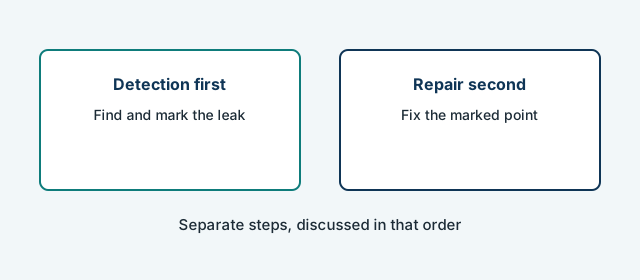
For a Duluth home, the practical sequence is: photograph and note, detect and narrow, ask the carrier the five questions, then open and repair. Detection services that fit that sequence are ceiling leak detection, slab leak detection, and wall leak detection, each with the same ruled-out discipline: a cause is stated, or a referral is named, but a location is not guessed. That discipline is what makes a detection report useful to a carrier as well as to a homeowner.
Insurance and a hidden leak in Georgia: what not to assume
Do not assume a leak is covered because a neighbour's was, do not assume detection is covered because damage is, and do not assume a gradual leak will be treated as sudden because it was only just noticed. Each of those assumptions has cost homeowners a claim. The policy wording controls, the timeline is evidence, and the carrier's answers — asked before work, in writing — are the only answers that count. This guide does not replace them.
Common questions
Does homeowners insurance cover the cost of finding a leak?
Often not as a standalone cost. Detection is usually treated as part of the repair investigation rather than as damage itself, so it may be limited or excluded even when the resulting damage is covered. Ask your carrier specifically whether detection is covered, separately from damage and access, before work starts.
What is the difference between sudden and gradual leaks for insurance?
A sudden, accidental leak — a pipe that bursts or a joint that fails without warning — is usually treated as a covered peril. A gradual leak — a slow seep that has stained over months, or a leak known about and left — is usually treated as maintenance and is usually not covered. Dated photos and a prompt inspection help show which side of the line a leak falls on.
Should I file a claim before detection?
Ask your carrier first. Some carriers want an adjuster to see the damage before any opening, and opening before that visit can complicate a claim. Detection that narrows without opening fits that sequence well, because it produces a report without disturbing the damage. Do not open a wall or ceiling before the carrier's answer if a claim is planned.
What if there is no damage yet, just a suspected leak?
A standalone inspection with no damage is usually treated as maintenance, not as a claim, and filing a claim for an inspection alone can be recorded even when nothing is paid. The value of early detection in that case is finding the leak before it becomes damage — which is cheaper to fix, covered or not.
Does this guide guarantee my claim will be covered?
No. This guide is general information only, not insurance advice, and it does not interpret your policy. Policies vary, endorsements change the answer, and the only authority on your claim is your carrier and your policy wording. Ask the five questions in this guide, in writing, before work starts.