 Duluth Water Leak Detection Pros
What Pipe Materials Are in Duluth Homes, and How Do They Leak?
Duluth homes, in ZIP codes 30096 and 30097, contain copper, PEX, PVC, and in older homes galvanized steel or polybutylene — and each one leaks differently. Knowing the material helps narrow a leak, because each fails in its own way.
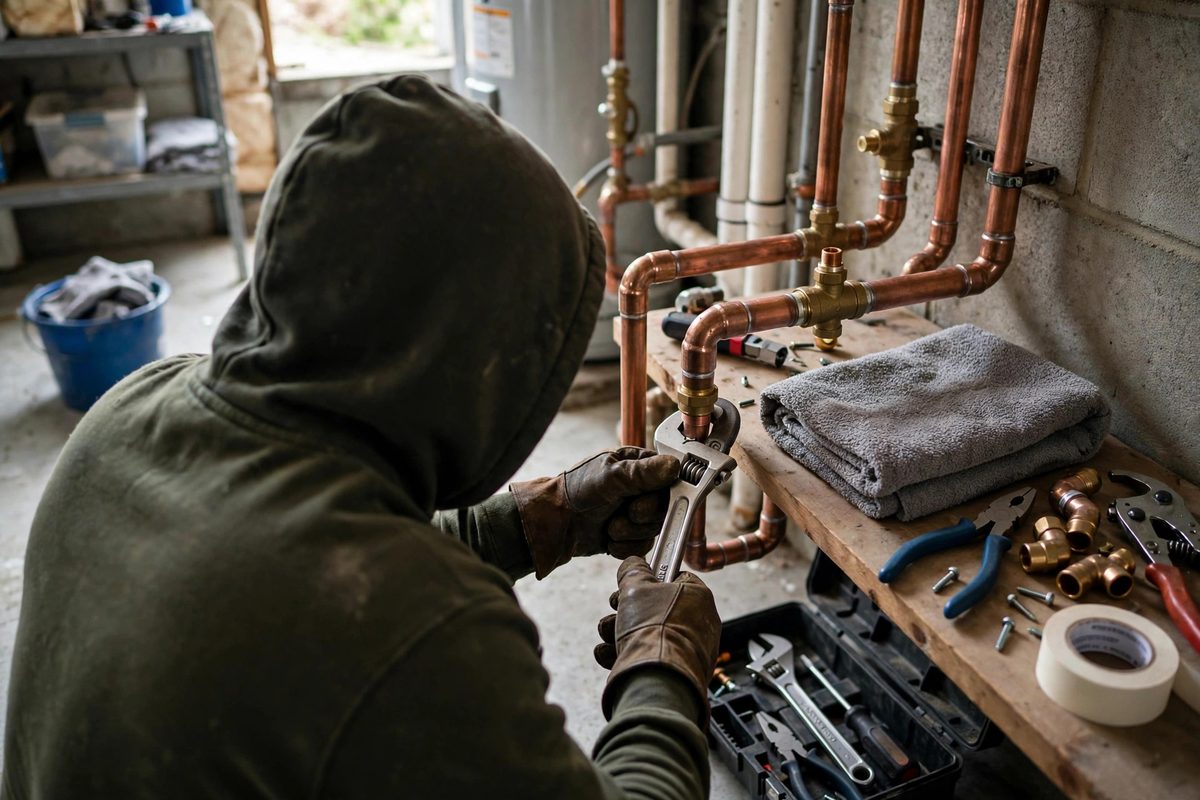
“What kind of pipes do I have?” is a question worth answering before a leak, not after one. The material determines where a leak is likely to start, how it shows, and how it is found. A copper leak at a joint, a PEX leak at a fitting, a galvanized leak from internal corrosion, and a polybutylene leak from material failure are four different problems, and the inspection treats them as such.
Pipe materials compared
| Material | Where found | How it usually leaks | Detection note |
|---|---|---|---|
| Copper | Supply lines, many ages | Pinhole corrosion, joint failure | Acoustic and thermal work well; hot lines show thermally |
| PEX | Newer supply lines | Fitting failure, not the pipe itself | Check fittings first; the pipe rarely fails alone |
| PVC / CPVC | Drains (PVC), some supply (CPVC) | Joint failure, cracking under stress | Drain leaks do not move the meter |
| Galvanized steel | Older supply lines | Internal corrosion, narrowing, then leaking | Often low pressure as well as leaking |
| Polybutylene | Older homes, 1970s–1990s era | Material failure at fittings and along the pipe | Flag for a plumber's assessment, not just a leak mark |
The table is general, not a diagnosis for any one home. A home can contain more than one material — copper in one section, PEX in an addition, galvanized in an older run — and the material at the leak is what matters, not the material in the rest of the house. That is why the inspection narrows to a point first, and the material question is answered at that point.
How material changes the inspection
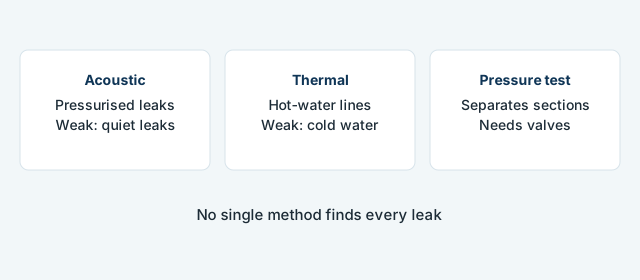
Material changes which checks are most useful. Copper hot-water lines show well on thermal imaging, because the temperature difference is clear. PEX fittings are checked first when a PEX system leaks, because the pipe itself is rarely the failure. Galvanized lines, which corrode from the inside, often show low pressure alongside a leak, and that combination points to a system question, not just a single leak. Polybutylene, where present, is a flag for a broader assessment: a single leak in a polybutylene system can be the first of several, and a plumber's assessment of the system is worth more than a single marked point.
Material also changes what a leak sounds like. Acoustic listening picks up pressurised water escaping, but the sound varies with pipe material, depth, and covering. A quiet leak in a plastic line can be harder to hear than a leak in copper, which is why acoustic results are combined with thermal, moisture, and meter checks rather than trusted alone.
How to find out what pipes you have
Look where pipes are visible: under sinks, near the water heater, and at the main valve. Copper is reddish-brown metal, PEX is flexible plastic tubing (often red, blue, or white), PVC is white rigid plastic, galvanized is grey metal with threaded joints, and polybutylene is usually grey flexible plastic. If you cannot tell, photograph what you can see and describe it on the call — the inspection will confirm the material at the marked point, and that confirmation is part of the report.
Pipe materials and hidden leaks in Duluth, GA
For a Duluth home, the practical takeaway is simple: know the material where you can, watch for the failure pattern that material is known for, and let the inspection narrow before any opening. A copper pinhole, a PEX fitting, a galvanized corrosion leak, and a polybutylene failure are all found the same way — meter, isolation, narrowing, marking — but they are repaired differently, and the repair discussion should name the material, not just the point. The service pages that cover the locations are slab, wall, and water line leak detection.
When a material question becomes a repiping question
A single leak in any material is usually a spot repair. A pattern of leaks in the same material is a different conversation. Galvanized lines that corrode throughout, polybutylene systems that fail at multiple fittings, and copper systems with repeated pinhole leaks all point the same way: the material itself, not a single joint, is reaching the end of its useful life. At that point, the question stops being “where is this leak?” and becomes “how many more leaks will this system produce, and what does replacing it cost compared with repairing it one leak at a time?”
That second question is a plumber's assessment, and it should be made on evidence, not on a single leak. The evidence is the leak file: locations, materials, dates, and marked points, kept in one place. A plumber who sees that file can judge whether spot repairs are still sensible, whether a section replacement makes sense, or whether a full repiping discussion is due. A plumber who sees only the latest leak cannot make that judgement, and neither can a homeowner who has not kept the records. Detection contributes to that file with marked points and material confirmations; it does not price repiping, and it does not decide it.
Two cautions for the repiping conversation. First, do not let a single leak panic you into a full repiping decision — one leak, in any material, does not prove a system is failing. Second, do not let repeated leaks lull you into endless spot repairs either — each spot repair that ignores the pattern is money spent on a system that will leak again. The middle path is the file: keep it, show it, and let the pattern, not the latest leak, decide.
Reading a leak by its location and material together
Location and material together tell a story that neither tells alone. A leak under a slab in a home with galvanized lines points to corrosion in a line that is hard to access. A leak at a fitting in a PEX system points to a fitting, not to the pipe, and the fix is local. A leak in a wall in a copper system, with a warm patch, points to a hot-water line and shows well thermally. A leak that appears in several places in a polybutylene system points to the system, not to any one spot. The inspection reads location and material together, and the report should name both — not just a point, but a point in a material, in a location, with a failure pattern that fits.
That combination also helps a homeowner judge urgency. A single fitting leak in a newer system is usually a local repair. Repeated leaks in an older material, in different locations, are a system conversation. And a leak in a material known for systemic failure, even if it is the first leak, is worth a system assessment alongside the spot repair — not instead of it, but alongside it, so the next leak does not come as a surprise. The material guide and the leak file, kept together, are what make that judgement possible.
Common questions
What pipe material leaks most often?
That depends on age and system, not on material alone. Copper leaks from pinhole corrosion and joint failure, PEX leaks at fittings rather than in the pipe, galvanized leaks from internal corrosion, and polybutylene leaks from material failure. The material at the leak is what matters, and it is confirmed at the marked point.
How do I find out what pipes my home has?
Look where pipes are visible: under sinks, near the water heater, and at the main valve. Copper is reddish-brown metal, PEX is flexible plastic tubing, PVC is white rigid plastic, galvanized is grey metal with threaded joints, and polybutylene is usually grey flexible plastic. Photograph what you see if you are unsure.
Does pipe material change how a leak is found?
Yes, in which checks are most useful. Copper hot-water lines show well thermally, PEX fittings are checked first, galvanized lines often show low pressure alongside a leak, and quiet leaks in plastic lines can be harder to hear acoustically. That is why checks are combined rather than trusted alone.
Is polybutylene a special case?
Yes. Polybutylene, found in some older homes, can fail at fittings and along the pipe, and a single leak can be the first of several. A plumber's assessment of the whole system is worth more than a single marked point, and that assessment should be part of the repair discussion.
Can detection tell me the material without opening anything?
Partly. Visible sections can be identified, and the inspection can narrow to a point and infer likely material from the system and the checks. The material at a concealed point is confirmed when that point is opened — detection marks the point, and opening confirms the material.