 Duluth Water Leak Detection Pros
Winter Frozen Pipe Leaks in Duluth, GA: What to Check Before and After a Freeze
A frozen pipe in Duluth, GA can crack while frozen and leak only when it thaws. No water, low pressure, or a damp patch after a cold night is worth a meter test. Shut off the main valve if it is safe to reach, then call with your meter result.
How a freeze breaks a pipe
Water expands as it freezes. When a section of pipe freezes solid, the ice does not just sit there: it blocks the pipe, and the water trapped between two blocks of ice has nowhere to go as it too turns to ice and expands. Pressure builds in that trapped section until the pipe splits, often at a joint or a thin spot rather than exactly where the ice formed. That is why the split and the ice are not always in the same place, and why finding the frozen section is not the same as finding the leak.
The second part matters just as much. While the pipe is frozen solid, no water flows through it, so a split may show nothing at all. The leak appears when the pipe thaws and water flows again through the split. A home can therefore look fine all through the freeze and start showing a damp patch, a stain, or a bill spike days later, once water is moving again. "It was fine during the freeze" does not rule out a freeze-caused leak, and a leak that appears after a thaw is not necessarily a new problem: it may be a freeze split revealing itself.
Not every frozen pipe bursts. Many pipes freeze and thaw with no split at all, and the only symptom is no water or low pressure while the ice is there. That distinction is worth holding onto, because it decides what to do next. A pipe that is frozen but intact needs thawing and watching. A pipe that split needs its location marked before any opening, which is where detection comes in. The meter test below is what separates those two cases without opening anything.
Where Duluth homes are most exposed
Duluth winters can bring freezes, and the pipes most at risk are the ones that sit where the house is coldest. Pipes in unheated crawl spaces, pipes running through attics, pipes in exterior walls, and outdoor faucets and hose bibbs are the usual exposure points, because they sit outside the heated rooms or against cold air. A garage that is not heated counts the same way. None of this is specific to one style of Duluth home: any home with a pipe in an unheated space has a section worth knowing about before a cold night, not after one.
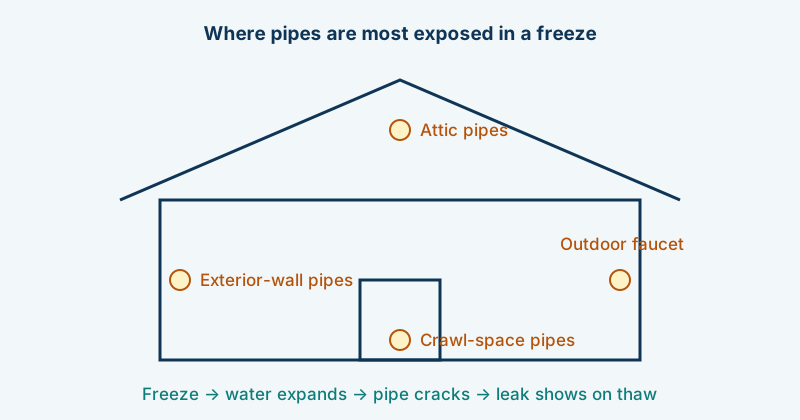
Knowing where your exposed sections are is practical, not technical. It tells you which taps to check first after a cold night, and it tells us on the call which parts of the system to think about first. It also explains a pattern homeowners often find confusing: one tap with no water while the rest of the house works normally. That usually points to a single frozen branch, not to the whole supply, and it narrows the search before any check is run.
Signs after a cold night or a thaw
Freeze symptoms come in two groups, and they mean different things. Symptoms during the freeze are mostly about blockage: water cannot get through ice. Symptoms after the thaw are mostly about a split: water is now escaping through it. Reading them in that order keeps a homeowner from mistaking one for the other.
| Sign | What it may mean |
|---|---|
| No water at any tap | The main supply section is frozen, or the main valve is shut |
| No water at one tap only | That branch is frozen, while the rest of the supply still flows |
| Low pressure after a cold night | A partial freeze narrowing the pipe, or a leak opening as ice clears |
| Damp patch or stain appearing as things thaw | A split leaking now that water flows again |
| Bill spike days after a freeze | A slow leak from a split that was not noticed at thaw |
| Meter moves with every tap off | Water is escaping somewhere — the result that points to a leak |
One result deserves emphasis, because it is easy to misread. A frozen pipe with no split does not make the meter move: the water is blocked, not escaping. So a meter that does not move after a freeze does not prove there is no split — it may mean the section is still frozen and water is not yet flowing through it. That is why the meter test is worth repeating once pipes have thawed, and why "the meter did not move" is information to pass on with the timing, not a final answer on its own.
What to do first
If water is showing, or if a tap has no water after a cold night, start with the same order every time. First, shut off the main water valve if it is safe to reach. That single step limits how much water a split can release once thaw comes, and it is worth doing before anything is opened or investigated. If the valve is hard to reach, stuck, or near wet electrics, leave it and say so on the call rather than forcing it.
Second, keep clear of wet electrical outlets and switches, and move valuables away from spreading water. Third, do not use an open flame to thaw a pipe, and do not cut a wall, floor, or ceiling to look for the split. Opening a surface before the location is known is exactly how a small freeze problem turns into a large repair, because water travels before it shows and the damp patch is rarely the split itself. Fourth, note what you are seeing: which taps are affected, when the cold hit, whether the main valve is open or shut, and what the meter shows. Then call with that list, your ZIP code, and your meter result if you have one.
One more thing to say on the call, plainly: whether your pipes are still frozen. That changes how the visit is planned, because some checks need water flowing and pressure in the line. Telling us the pipes are still frozen is not a reason to wait in silence — it is the detail that lets the visit be planned around the thaw instead of arriving to find checks that cannot yet run.
What detection checks after a freeze
Detection after a freeze follows the same inspection as any hidden leak, because the question is the same: where is water escaping, and where should repair open? It starts with the meter test. Turn every tap off, read the meter, wait without using water, then read it again. If it moved, water is escaping somewhere even though nothing is running. If it did not move, either there is no flowing leak, or the section is still frozen and water is not yet reaching the split — both are useful results, and both are worth reporting with their timing.
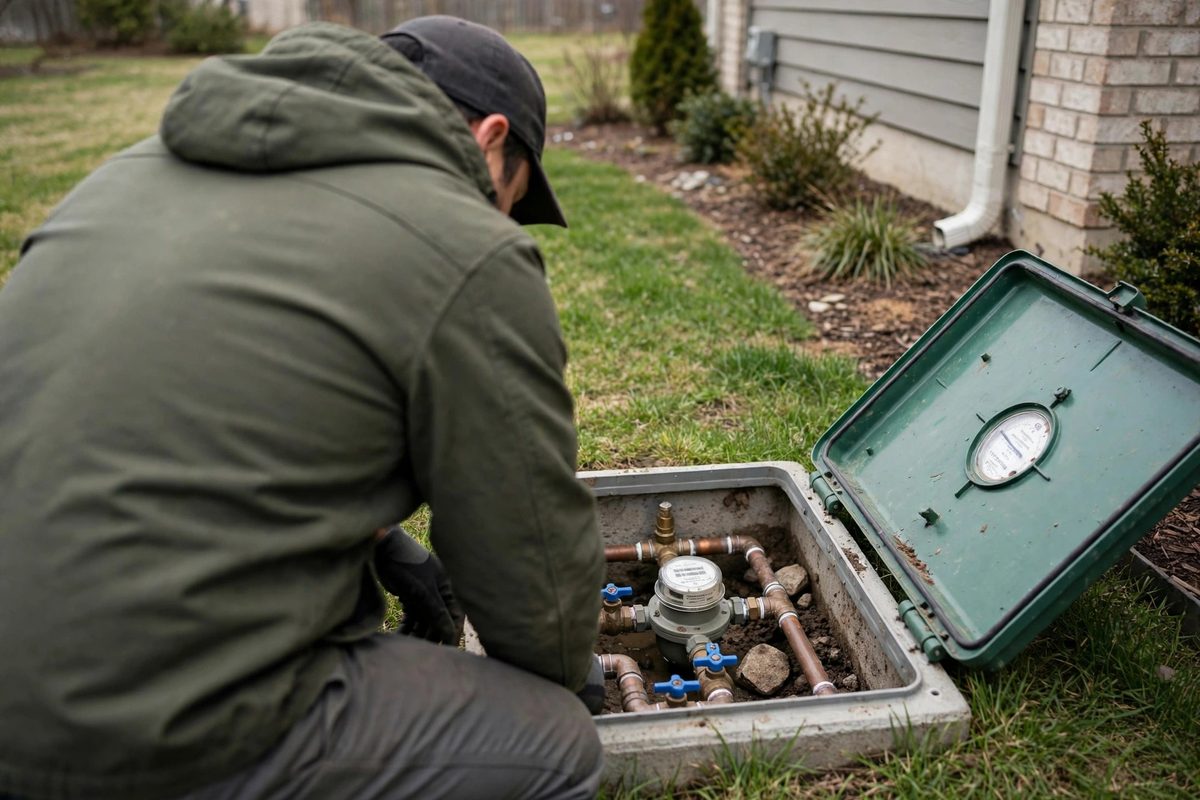
Next comes isolation: close the house shutoff valve. If the meter stops, the leak is inside. If it keeps moving, it is in the buried line outside. That test decides whether the search is an inside check or an underground check, and it matters after a freeze because a buried line and an interior line freeze and thaw differently. Then the remaining section is narrowed with acoustic listening, thermal imaging, moisture readings, and pressure checks, chosen for the symptoms. Each has a limit that stays in view: acoustic listening is weak on quiet leaks, thermal imaging is weak on cold-water lines and does not see through walls, moisture readings show spread rather than the exact source, and pressure checks need valves and access to each section. A location several checks agree on is more reliable than one from a single check, and if the checks point to different places, the result is stated as inconclusive.
What detection does not claim after a freeze is just as important. It does not promise thawing as part of detection, and it does not promise a duration or a same-day outcome on this site. If pipes are still frozen, some checks may need to wait for thaw, and that is said plainly on the call rather than discovered at the door. What you get is a marked location and an explanation of the next step for repair, not a guess and not an opening made to search.
Before the next cold night
Most of the useful preparation for a freeze is knowing things before you need them. Know where your main shutoff valve is, and check that you can reach it and turn it. Know which of your taps sit on exterior walls or run through unheated spaces, so a no-water tap after a cold night points somewhere specific instead of everywhere at once. Disconnect garden hoses from outdoor faucets before cold weather, so a hose does not trap water against the faucet. None of these steps is a service we sell: they are homeowner preparation, and they cost nothing except a few minutes before the first cold night.
After a cold night, keep the meter-test habit even if nothing looks wrong. A split that leaks slowly may not show a damp patch for days, and the bill is often the first sign that catches it. Comparing bill volume as well as charge, checking whether a reading was estimated or actual, and running the meter test with everything off are the same first checks that apply to any hidden leak, and they apply with particular force after a freeze, when a slow split is easy to miss.
When it is not a frozen pipe
Not every winter damp patch is a freeze split. Damp that comes and goes with cold, humid air, with a meter that does not move, can be condensation rather than a pipe leak, and it behaves differently: it appears and fades with the air, not with water use. A leak that was already raising the bill before the freeze is not explained by one cold night either, and it should not be filed under winter just because winter is when it was noticed. And if the whole street has no water, the likelier explanation is the supply itself rather than your pipes — worth checking with neighbours or the utility before assuming a frozen main. Each of these cases is separated the same way: the meter test, the timing, and what the checks agree on, not the season alone.
Common questions
Does a frozen pipe always burst?
No. Many pipes freeze and thaw with no split at all, and the only symptom while frozen is no water or low pressure at affected taps. A burst happens when expanding ice builds pressure in a trapped section until the pipe splits, usually at a joint or thin spot. Only checks confirm a split: a meter that moves with every tap off points to water escaping, while a meter that does not move may mean the section is still frozen.
How do I know if the leak is from a freeze or something else?
Timing is the first clue. A leak that appears during or just after a cold night, especially with no-water or low-pressure symptoms, fits a freeze split. A leak whose bill was rising before the freeze, or damp that comes and goes with humid air while the meter does not move, points elsewhere. The meter test and the isolation test then separate the cases: they show whether water is escaping, and whether the leak is inside or buried.
Should I wait for the thaw before calling?
No. Call and say plainly whether your pipes are still frozen, along with your ZIP code, which taps are affected, and your meter result if you have one. That detail lets the visit be planned around the thaw instead of arriving to find checks that cannot yet run. Waiting in silence risks the other outcome: a split that starts leaking as soon as thaw comes, while nobody yet knows where it is.
Can detection find a leak while pipes are still frozen?
Not always, and that limit is stated. Acoustic, thermal, moisture, and pressure checks need water flowing or pressure in the line to narrow a location, and a frozen section may block both. If the section is still frozen, some checks may need to wait for thaw, and if the checks that can run do not agree, the result is stated as inconclusive rather than guessed. Saying the pipes are still frozen on the call lets that be planned honestly.
What should I tell you on the call after a freeze?
Your ZIP code, which taps have no water or low pressure, when the cold hit, whether the main valve is open or shut, whether your pipes are still frozen, and what the meter showed with every tap off. That list narrows the search: inside or buried, frozen or thawed, flowing leak or blocked pipe. Bring the meter result if you have done the test; if you have not, the call still starts with those questions.