 Duluth Water Leak Detection Pros
Leak Inspection Checklist Generator for Duluth, GA
Tick the symptoms you have, and this generator builds a checklist: the checks to run, what to note down, and what to tell us on the call. The meter test and shutoff test are always on the list, because they decide inside versus buried before anything is opened.
The generator
How to use the generator
Tick every symptom that applies, then press the button. The generator builds three lists: the checks to run, what to note down, and what to tell us on the call. The meter test and the shutoff test are always on the list, because they decide inside versus buried before anything is opened. If water is showing and spreading, skip the generator, shut off the main valve if it is safe to reach, and call first.
After you build it
Work through the checks in order, starting with the meter test and the shutoff test, since those two decide the shape of everything after them. Write the notes down as they are found, rather than trusting memory on the call: a patch size, a date first seen, and a meter result are worth more than a general description. Keep the printed list to hand for the call, and bring it to the visit if one is arranged, since it records what was already checked and what was not.
Do not open anything to complete the checklist. No item on it requires opening a wall, a floor, or the ground, and opening on a guess can miss the leak while adding repair work. If a check cannot be done safely, such as a shutoff that is stuck or cannot be reached, note that instead of forcing it, and say so on the call. A check that cannot be done is still information, because it tells the visit where to start.
What this generator does not do
The generator organises evidence. It does not diagnose a leak, locate water behind a wall, or decide whether a symptom is a leak at all. Damp spread is not the same as a leak source, a musty smell is not proof of a pipe leak, and a soggy patch can have causes other than a buried line. Only the meter test proves water is escaping, and only the narrowing checks locate it. The checklist makes the call and the visit sharper. It never replaces them.

Symptom by symptom: what each one can mean
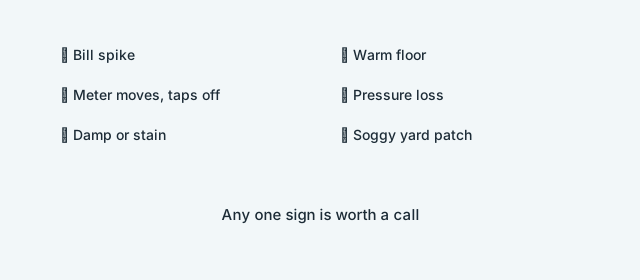
Each symptom on the generator points somewhere, but none of them points conclusively. The table below is the reasoning behind the checklist: what a symptom can mean, and which check comes first for it. Treat every row as a suggestion for where to look, not as a diagnosis, because only the meter test proves water is escaping and only the narrowing checks locate it.
| Symptom | What it can mean | First check |
|---|---|---|
| Bill volume up | Water escaping somewhere, or use changed | Bill comparison, then meter test |
| Damp patch or stain | Water reaching a surface from a nearby pipe | Meter test, then moisture readings for spread |
| Warm spot on a floor | Warm water escaping under the floor | Meter test, then thermal imaging |
| Low pressure | Water diverted by a break, or another supply cause | Meter test, then note which taps are affected |
| Soggy yard patch | Buried line water reaching the surface | Shutoff test, then buried-line narrowing |
| Musty smell | Long-running damp, not necessarily an active pipe leak | Meter test, then moisture readings |
| Sound of running water | Water escaping under pressure nearby | Meter test, then acoustic listening |
| Water showing now | Active escape needing shutoff first | Shutoff if safe, then call immediately |
Patterns across symptoms matter more than any single one. A bill rise plus a damp patch is a stronger picture than either alone, because two independent signs agree. A warm floor plus a bill rise points toward a warm-water line under the floor, which is why thermal imaging fits that pair. A soggy yard patch plus a meter that keeps moving with the shutoff closed points toward a buried line, which is why the shutoff test comes before any digging or listening in the yard. The generator builds these patterns into its lists, but the visit is where they are tested, not where they are assumed.
The order that saves time
Checks have an order, and following it saves a visit from wandering. First, the meter test, because it proves water is escaping at all. Second, the shutoff test, because it divides the search into inside and buried at once. Third, the symptom checks, because they narrow within the half the shutoff test selected. Fourth, the call, with all three stages of results to hand. Running symptom checks before the meter test is like searching rooms before confirming anything is missing: it can work, but it wastes effort when the first two tests would have halved the search.
The one exception to the order is water showing and spreading. Then the order collapses to two steps: shut off the main valve if it is safe to reach, and call. The meter test, the checklist, and the notes can wait until water is stopped, because every minute of spreading water adds damage that no checklist can undo. The generator states this exception in its own instructions, and it is the only symptom for which skipping the order is the right move.
What not to do while checking
Four things should not happen while working through a checklist. Do not open a wall, a floor, or the ground to look for the leak, since opening on a guess misses more often than it finds and adds repair work. Do not force a stuck shutoff valve, since a forced valve can break and turn a leak into a flood. Do not run water deliberately to test a symptom, since the meter test needs everything off and a deliberate run contaminates it. And do not delay the call until every note is perfect, since a partial checklist with accurate notes beats a complete one with guessed entries, and the call itself is free to make.
What to do instead is simpler: note what is known, mark what is unknown as unknown, and let the visit fill the gaps. A note that says the shutoff could not be found is useful. A note that guesses its location is not. The checklist is a tool for making the unknown visible, not for hiding it behind tidy answers, and the visit respects an honest gap far more than a confident error.
Keeping the list after the call
A checklist does not expire when the call ends. Keep it for the visit, since it records what was already checked, what was found, and what remains unknown, and a visit that starts from that record wastes no time repeating work. Update it as the visit adds results: the meter figure, the shutoff result, and the marked location, if one is found, all belong on the same list that started the process.
Keep it after the visit too, for the repair discussion that follows. The repairer can see what was found and where, and any later change, such as a new damp patch or a bill that stays high, can be compared against the original list instead of against memory. A checklist kept this way becomes a small record of the leak, from first symptom to repair, and that record is worth more than any single note taken on the day.
Common questions about checking a water meter for a leak
Do I have to do every check on the list?
No. Start with the two base checks, the meter test and the shutoff test, since those decide inside versus buried. Symptom checks after that are as relevant: run the ones that match what is showing, and skip the rest. A partial checklist with accurate notes is worth more than a complete one with guessed entries, and the call works with whatever has genuinely been checked.
What if I tick nothing?
The base checklist still builds: the meter test, the shutoff test, and the notes to take. Ticking nothing simply means no symptom was selected, so the generator cannot tailor the list. If symptoms are showing but none of the eight boxes fits, describe what is showing on the call instead, and the visit starts from that description plus the two base tests.
Can I print the checklist?
Yes. Press the print button after building the list, or use the browser print command. The printed list carries the checks, the notes, and the call list, so it can be worked through at home and brought to the visit. If printing is not available, a screenshot of the built list serves the same purpose, since the content is the list itself, not the format.
Does this checklist diagnose my leak?
No. It organises what is already known into checks, notes, and a call list. Diagnosis needs the meter test to prove water is escaping and the narrowing checks to locate it, and neither happens by ticking boxes. The checklist sharpens the call and the visit by making symptoms specific. It never locates water, and it never replaces an inspection.